FAQs
We have composed a list of FAQs (Frequently Asked Questions) to some common questions about planning and undertaking a trip such as London to Cape Town or Cape to Cairo. They are equally applicable to any long term expedition / trip planning for RTW, Americas, Oz or Asia.
London to Cape Town, which Route?
London to Cape Town – it’s a classic trail and there are 2 principle routes: The East Coast route (Cape to Cairo or Cairo to Cape) or The West Coast route via West & Central Africa. Within these routes there are a couple of sub-routes and options to consider. The days of being able to go through Africa in a straight line (Algeria to Cape) are no longer viable although circumstances and changes to plans may mean you end up visiting parts of the old colonial routes along the way (we ended up in a remote part of DRC and saw signs for the Belgium Congo!). Some of these route options are discussed in more detail in the Bradt Overland Guide which is a good high level planning guide - see our blog for more details. In general terms, the East coast route is more popular with overlanders and overland companies so is more touristy. The West Coast is more challenging but arguably more rewarding as its less traveled. Some people do this route in 2 stages - UK to Ghana (ship to Namibia) Namibia to South Africa - by doing this you miss out Central Africa..... our advice is drive the whole way - Central Africa is beautiful, no more risky than the countries that you have just driven through and an experience you will never forget.
Would you do it again?
Yes - and stop in places for longer. Some people "rush" the entire trip for a variety of reasons but try not to, it pays to e.g. sit down and chat with a village chief, ask to visit a local school, take an interest in the people and share your own experiences. You will be amazed at what can happen.
Any regrets?
Personally
None - Apart from some visa constraints that meant we could not stay for as long as we wanted in Central Africa we have no regrets - the trip was well worth it and if you are reading this thinking "but what about my job, house, possessions etc...." all we can say is don't worry - when you finish the trip you wont be worrying so much about that kind of thing anyway.
Socially / Envirionmentally
Lots - You notice that the so called "Western way of life" is taking hold in Africa and its not a cheap place to visit, capitalism is a live and well and VERY much so in places like Luanda, Angola. Net effect = mass influx of cheap goods, vast destruction of the rain forest and depletion of wild animals. After a while it washes over you but its a real eye opener and helped put a few things in context with respect to our own lives.
Sad Westerners
Yes - Treating Africa like some glorified club 18-30 resort holiday and expecting everything for free. Some commercial Overland companies (not all) have "perfected" the art of taking people on a "trip of a lifetime" in Africa which seems to mainly involve making lots of noise, taking over campsites, partying & drinking and walking around in various states of undress. We also met some pretty selfish overlanders who treat fellow travellers and accommodating hosts as "one way trading partners" expecting you to help plug the holes in their own trip because they are too tight / selfish to do it for themselves.
The once free camping accommodation that has been offered by places like the Sheraton Hotel Abuja, Nigeria have been withdrawn because travelers have been taking advantage of them (washing clothes in a 5 star swimming pool for example, taking over shared facilities, traveling with a dog and leaving it barking all day in a hotel car park etc etc....). You see a lot less of commercial overland companies on the West Coast. Apart from a few great folk we hooked up along the way, we tended to find the best experiences were when you were alone and away from this kind of crowd.
What's it like to be on the road with your partner / wife / husband for 366 days?
No.1 - Its not a holiday! .....It takes a while to get into the groove of being on the road.
No.2 - Living in a vehicle is like living on a boat ...Everything has a place - don't be untidy ;-)
No.3 - You will have arguments....if you can survive this you can survive anything ;-))
Note: Its a fact that some relationships don't make it and last until the trip is over. This is obviously very sad and would never wish this on anyone BUT it shows that a trip like this does exert pressure on your relationship be that a traveling friend, your long term partner or spouse. We saw a quote from a guy who travelled round the world with his wife on a tandem. When asked, "what impact does a trip like this have on your relationship?" he said, "It accelerates it in the direction its already heading!" If you have any doubts, talk to your friend or partner about them as different opinions, views and desires on a trip like this will tend to unearth bigger problems. Hard to deal with but one to make a note of.
Did you carry a gun?
This is by far the #1 question we get asked. The answer is "NO", Why......?
1) You will quickly realise why you don't need a gun when you start the trip and any thinking you originally had about taking a gun will quickly disappear
2) If you get caught with a gun at a border you are in a heap of trouble and at a minimum laying yourself open to a massive fine or time in an African jail!!
3) Ask yourself.......Have you ever used a gun? Do you think you could use a gun on another human being? If you produce a gun its only going to make things worse.....!!
We did take Panga and axe that you could argue are weapons. These were for chopping wood, bush etc.... its the most common tool "weapon" you will see in Africa and considering that children walk to school with Pangas and almost everyone has one, you never feel threatened. We found that a torch is actually a good "weapon" to use in situations (typically at night) when you might have to deal with people visiting camp / making noise....or simply being what most people are in Africa....CURIOUS. You shine a powerful light at people (or an animal) and they tend to pay attention and realise that you know they are there..... then go away.
What was your favourite country?
This is the second most asked question. Simply put, they are all great in their own way for their own set of reasons. Countries we felt we would love to go back to are Morocco, Western Sahara, Ghana, Cameroon, DRC, Angola, Zimbabwe - all great countries with amazing people and scenery. There was a lot of police corruption in Northern Senegal which is a shame as its a great country.
How many bribes did you pay, how do you avoid paying bribes?
Officially ... one. We had to "pay" for "help" £30 to cross the border from Mauritania to Senegal at Rosso. We also paid a couple of traffic fines £13 & £15 (one of which was a marginal Red / Amber light in Burkina Faso). So all in all, we got away pretty lightly and anyone that tells you they never paid a bribe or got ripped off is either telling fibs or simply didn't realise. A few people tried it on in Southern Morocco, Senegal, Nigeria, poor towns in Namibia and Mali.....the classic question is "have you got anything for me"? The answer can vary depending on how you feel - some of these guys simply like a cold glass of water or a cigarette - and why not - they don't get paid much. It can also help break the ice. But so can speaking the local language, discussing the national football team (a good one), being respectful and simply saying "no" also works. We never gave anything to anyone we felt didn't deserve it - we never gave anything to anyone that asked or begged for it (which is sometimes easier said than done).
Did you insure all your stuff & vehicle
- Vehicle - 3rd party only
- Stuff - No
- Medical - Yes
Vehicle insurance for an overland trip in Africa is something you buy as you go and having local paperwork is better than some expensive policy you got in Europe that no one recognises. We always got local 3rd party policies which are easy to get at the border - there is always someone selling them. For Morocco / WS we got a policy in local town - pop into any insurance company. Mauritania we got at the border. In Senegal we bought the Brown Card / ECOWOS policy at the border that saw us good until Congo. We winged it in DRC & Angola. Namibia is included in the fuel. Botswana & Zim & Moz you buy at the border. We got a 3rd party long term policy in SA as we now live here. Its all pretty cheap and it simply helps avoid fines for NOT having insurance. If you did have a crash I doubt they would ever pay out. We did try and get a few quotes before we left - one company in Denmark was offering something like €1500 for 1 year 3rd party with lots of exceptions. Go local, its a lot easier.
Stuff
Too complicated and too expensive. With so many countries to visit and exceptions etc......... its not really worth it. We were very security aware and always had a good routine when it came to storage and locking things away etc.... The excesses we were looking at were not worth it for say losing an old GSM phone plus we never felt like we were ever going to get robbed etc.... just be sensible, don't flash your gear around and try and be aware of your surroundings.
Medical
We got a full world medical travel policy for 1 year for both of us. We got it from www.travelnation.co.uk they are very pro-active, underwrite overland trips and can add bespoke clauses and exceptions etc..... we would recommend them.
How much cash did you take, how did you deal with money on the road?
Carry a mix of sources. Cash works well - we took Euro and US $ (as much as you feel comfortable losing). Don't bother with travellers cheques. Euro is best for North & West Africa. US $ is best for Central Africa, ZIM & Moz. You can use your credit card at most branded fuel stops and cash machines are available in most big cities. Changing money at borders was OK (black market or legitimate seemed to be the same exchange rate) and no one bats an eyelid when you get cash out to exchange with some guy behind a fence.
Make sure you send a note to both your bank and credit card provider letting them know the complete list of places you plan to go and how long you plan to be away.
We can take questions off line if you want to know exactly how we dealt with cash etc.....
London to Cape Town, is it dangerous?
In any country (developed or undeveloped) there are risks to travellers. Most of the “normal risks” such as mugging, pick pockets and robbery from your vehicle or person are really minimised by basic common sense and are only really needed in cities and border crossings – times when you tend to be distracted! Our findings from the trip were to “keep your head”, don’t be aggressive and be respectful. Bombings, kidnap and personal attacks tend to be confined to cities and tourist centres – rural Africa is very (relatively) safe, people are friendly and simply want to say hello, admire your vehicle and ask a few questions. Most of your fears are really a state of mind and you do adjust to the surroundings.
Did you wild camp (bush camp) in Africa on your own?
Finding a 100% wild camp is hard because after 30 minutes somebody (normally 2 boys) will come and visit you out of curiosity, try and sell you something or simply stand and discuss your attempts to "blend in". Its fun but also sometimes hard work as you tend to be tired after a long day... be patient and let them know why you are there. If you mean "wild" as in remote and absolutely on your own, you only really achieve this in remote deserts (e.g. NW Namibia) or thick forests of Central Africa. To be honest, it is a bit scary wild camping as Newbies as your "senses" become slightly more attuned to what is going on around you but we had no problems. If you have a hard drive and its getting dark, some useful places to consider (from our own experience) are: small remote villages (simply ask the head man if its OK), police stations, construction compounds, clinics, hotel car parks, small bars and farms.
What about wild animals - Are there any risks?
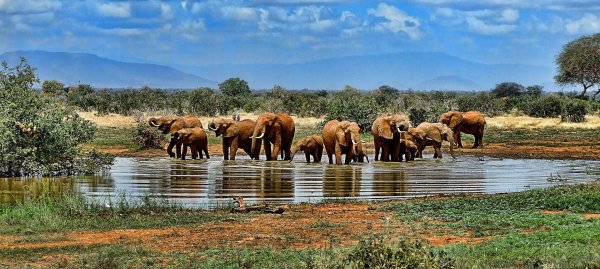
Remote bush camping means you will come into contact with wild (and we mean wild) animals, especially in Namibia, Botswana and Zimbabwe. Lions, elephants, baboons, hippos & crocs are all animals you will see / encounter if you camp in the bush. We encountered all 5 with lions roaring under our vehicle awning for 2 hours, elephants brushing against our tent, hippos visiting camp, baboons on the run and crocs swimming in the river. Hippos / crocs are perhaps the most dangerous, especially on or near river banks. I am told by my wife lions are not interested in humans! Yeah right! They do eat people and you are relatively safe in your roof tent (gulp). Monkeys and elephants like most human food, can smell it from a great distance and can run through camp causing a right mess in search of things like citrus fruits etc.....avoid herds of elephants with young and bull males that are aroused (they have a 5th leg - its not hard to miss). Such encounters can be scary but be calm, don't make noise, stay still and slowly withdraw once they have passed. Ask locally about what's around you, study the locality, work out an escape route (with or without your vehicle) and sleep with a powerful torch (& your Panga). We generally parked our car at night so it was easy to drive away towards the main track if we ran into trouble.
London to Cape Town border etiquette, how should we approach this?
We never experienced any problems at borders (except a couple of aggressive kids at Rosso). We always tried to camp nearby the day before and give ourselves a day to cross a border. Even at Rosso it was more about how you approached the people / security / police and army that was key. Being patient is key, use a happy greeting, shake hands, use “Sir, Madam, Officer” and give yourself plenty of time. Try to speak the local language and accept that you may be asked “for something”. Be polite and realise that some of these border posts e.g. Congo, DRC are remote and not often visited by tourists. Your Carnet and Visa help mitigate the requests for “payment” when it comes to guards that maybe asking for money. We carried a small laminated map of Africa with our route on - a real help when things got tricky and not just at customs ;-)
London to Cape Town visas, should I get them in advance?
As a general rule – DON’T get visas in advance but don't leave it to chance at the border UNLESS you have good local / recent data on this from a credible source. There are two main reasons for this:
1) You create a deadline for yourself. This is not a good idea. Remember you are probably only going to do this trip once and so if you find a “paradise beach” you want to stay at longer than planned BUT have to leave the country by day xx it leaves you little room for manoeuvre.
2) If you get a series of visas you compound issue 1) even more but the main risk is that if you become sick or get involved in an accident as such a delay may have serious knock on effects on timing and cost. You can bag several visas in one city along the way (e.g. Nigeria – you can get Cameroon, Angola & Congo Brazzaville. Exceptions to this are for Angola – it’s very hard to get a 30 day tourist visa for Angola unless you get it in advance.
NB: with recent unrest in Ivory Coast and DRC Visas for these countries and sometimes neighboring countries become tricky. As of Dec 2011, there are reported issues with Ghana, DRC and Angolan visas. Check the HUBB visa section for up to date info.
London to Cape Town visas, should we ship our car to South Africa and prepare it there?
Its worth considering as a lot of overland kit (roof tents etc...) are made in South Africa. Also the labour associate with vehicle prep is lower. I would also argue that you can get much cheaper deals on the costs of fabricating bespoke items (metal boxes, vehicle mods etc....) We would have considered this as an option to save money but as we were driving here for ever it was not feasible. We could hook you up with some key contacts in Cape Town if you want to ship and prep your vehicle here. With the weaker Rand you are getting better value as it has been trading back at £1 = R13.
How did you import your car into South Africa?
If you are a "returning South African" like my wife you should read our Blog entry on the process to do this so you don't have to pay duty. Only returning citizens can import vehicles free of duty as long as you meet SARS / import criteria. They are a lot stricter on this now.
If you are not a South African you will have to enter on a Carnet and then leave with your vehicle on the Carnet OR pay duty OR do it illegally (we don't advocate the latter). For advice on this we suggest you contact a local clearing / shipping agent in say Cape Town. See above Blog post for details.
What about listing our trip with Africa Overland Network, The HUBB or Expedition Portal?
Yes - this is very much worth it. The Africa Overland Network is the original listing site and the Expedition Portal is good with more of a Americas focus. The HUBB - although originally for bikers now has dedicated 4x4 and Land Rover threads. We met up with people before we left and made new friends too. Its good to raise your profile, especially if you are working for a charity or good cause. These sites are packed full of data to help answer all your questions. Go to our links page to connect to them
Malaria – Is it worth taking pills?
It’s the age-old debate but here was our thinking:
• Malaria can kill you!
• Malaria can make a serious impact on your trip if you get it
• It a risk that can be minimised and managed
We spent 9 months travelling in Africa, (north, west, central & southern) to some pretty remote places and found a variety of people who had some pretty strange ideas about malaria and malaria pills / treatments. We met one traveller who had it 5 times and he looked very "ill" but said he was not taking the tablets.....need we say more!! I am not sure why people have such an "anti-malaria pill" attitude but the pre-treatments can and do help minimise your chances of developing the disease or assist the treatment should it be required if you develop Malaria during your trip.
The approach to Malaria has to be a combined approach and so the tablets are only one aspect. You can buy small test kits and most African clinics / doctors know exactly how to treat you. Time of year also has an impact on the mosquito populations for a given area / weather season you happen to be in. Data on this is available on the web. Covering up and using sprays also helps BUT you WILL get bitten on your trip. We took Doxycyclin for 8 months (daily) and apart from some initial constipation and sun sensitivity we were fine.
We had Malarone as a treatment should we develop Malaria and a few test kits that work on a pinprick blood test. Some travellers thought we were mad for taking them for this period of time - they also happened to be the people who said they were not taking anything. If you are living long term in Africa I could imagine your approach might change but only if you know the local area, the type of Malaria that is prevalent and when the peak season is. For people passing through, I think its better to be taking something rather than nothing. Since finishing the trip, we have stopped taking the pills after the defined period and have had no problems although we did get a few boils (not sure if this is related to the pills though).
What were the top 10 most useful items you took?
- Water filter - Hands down the best investment
- Multi-fuel stove - Efficient, don't need to fiddle with gas
- The COBB - Great for slow cooking, bulk food, BBQ, roasting & making pizzas!
- Vehicle Side Awning - Sun shade in tropics is essential
- Roberts SW Radio - Great for BBC World Service, news & African programmes
- Vehicle mounted side table - handy & space saving for cooking, esp. in rain
- Rear mounted tap - great for convenient washing of hands / kit / utensils
- Hammocks - nice alternative place to sleep and lie down on hot days
- Caravan power hook up - power was available in a lot of places (eases battery drain)
- SPOT Messenger - Excellent for location tracking, keeping friends & family up to date
- Camp Kitchen table - odd shape, bulky (we gave it away)
- Roof rack bag - Initially good, but leaked and rotted in sun (metal roof box better)
- Thermarests - never used, lent them to people once
- Large rucksacks - bulky, took up space, used once, used shoulder bags
- Money belts - never carried wallet, not needed (carry cash that you need)
- DC / AC converter - ours was a cheap one (not Sine Wave) buy better one next time
- Two way radios - only useful if other people know how to use them & switch them on!
- Board games - packed too deep in locker, pain to get out
- Random tools - took too many and hardly used them
- Lots of adaptors - took too many attachments, mainly used British plugs on multi-gang
- Don't rush! - You are on a journey of a life time, so take time to "stop" - we still spent 1 year on the road and in some countries wished we had stayed for longer
- Realise that it takes time to adapt from "9-5 normal life" to 1 year on the road - it takes approx 6-8 weeks to get used to life on the road - be prepared for that.
- Have improved storage in vehicle - we rushed our system / it self destructed!
- Sit inside / sleep in vehicle - It does get cold in Africa, good to be able to keep warm, get out of rain / damp
- Have roof tent open over the rear - its 50:50 on this - you gain shade at back
- Make sure its easy to get to fridge !!
- Try not to pack things in too many boxes - they take up space. Lockers are better.
- Take Blue metal water jerry cans - The Black plastic ones leak in the heat
- Take a spare alternator - It was the one item we should have packed
- Might consider alternative Malaria prophylaxis (just take test kits / treatment)
You should pack some spare parts and basic materials to make temporary repairs. A good thread on this can be found on the HUBB:
http://www.horizonsunlimited.com/hubb/land-rover-overland-tech/
There are 4 main reasons for this:
1) Knock on effects: In Central Africa you tend to have back to back visas so if you get delayed because of a small issue (e.g. broken water pump) the impact goes far beyond the issue of waiting for an expensive spare to turn up
2) Extremes: No matter how well prepped your vehicle is it is put under extremes on a long term overland trip. Heat, dust & grit, does strange things to things like seals, pumps, filters etc.... e.g. the heat destroyed our air hose on the compressor for example, which we swapped with our spare fuel line.
3) Expense - if you have to call on help in say Congo / DRC, it can cost. We heard of one couple who broke down - a tow cost the $500!! The garage they were taken to then ripped them off (i.e. the fix was sub standard) and the vehicle was broken into whilst in the garage.
4) Survival / safety - In the desert / bush you can find yourself stuck for the lack of a spare part or fix - e.g. cracked radiator. Whilst this is fine in Europe - 48'C shade temperatures, wild animals and a lack of people mean you are on your own, so its basically sensible to consider the "what if factor".
Whilst you cant pack everything, take some basics just to make life easier. Even though we had a basic spares kit, we still had to visit plenty of local garages for oil changes and small fixes along the way. We neglected (forgot) to pack the T55 torx bit that allows you to open the gearbox oil inspection nut - these are HARD to find in Africa!! A small item BUT caused us some fun and games to find one, which we did……in a plumbers shop in Congo!!
How easy is it to get water?
It’s pretty easy to get water, as long as you have a means to filter it. Village wells, springs and river were a few sources we used on the way. We had a ceramic / carbon filter and we used it daily and it must have saved us a fortune Vs buying bottled water. It also helped keep us healthy as we never really got ill on the trip. The Brownchurch system worked well for us.
What did you do about going to the toilet?
In our vehicle we had no toilet or porta-pottie. Actually, we didn't even have a bucket! Vicki used a She Wee and used it daily and as for No.2, well the bush is a pretty big place and finding a spot "to go" as nature intended (squatting) is the done thing. Its easier than you think - just make sure there are no Army Ants below you......those puppies BITE! Our Sea to Summit toilet roll holder (bag) was a major plus as you can put the paper around your neck offering "hands free" operation ;-) Another trick if you are looking for some "comfort" is to stop at a bar or motel and have a drink / ask to see some rooms..... then ask the question..... "do you have a toilet". Its fun to see what constitutes a toilet in Africa and after a while you might realise that going in the bush is a better option.
Did you eat street food in Africa?
Yes – do it and don’t look back. Its good value and generally well cooked. Favourites for us were Morocco, Ghana, Congo – African chilli sauce (commonly served in a plastic bag) can reach volcano strength so “test” some first before you spread it all over your meal ;-)
How easy is it to get fuel?
VERY easy and generally pretty clean. We did find fuel in Nigeria was “dirty” but our pre-filter took care of this. It basically pulls out the water and sludge before it gets to your standard fuel filter. Worth investing in. The only issue you may have is with remote locations (deserts) or local strikes prevent supply. Carry at least 20 litres spare at all times and increase your tank capacity. We could carry 100 litres in one tank with a range of almost 1000km.
How did you find cooking on the road?
Before we left we tried a few cooking options and looked at gas, liquid fuels and bbq type systems (The Cobb). The Cobb really proved its worth for slow cook bulk meals like chilli, curry, spag bol and pizzas! It really does make a wicked pizza and you appreciate this on the road. For day to day use we took a 2 x person Trangia (gas / liquid fuel options) which is a VERY efficient system for water boiling which is what you spend most of your time doing.
The multifuel burner for the Trangia is simple to use and we filled it with Aspen 4T Alkylate Petrol. This is ultra pure, enviro friendly petrol and you can buy it from many regional mower shops in the UK. Click this link here for more info. This fuel is cheap 5L costs £13 (0.5 L of Coleman fuel costs ~£7) and lasts a long time with this kind of burner – 10 litres lasted us for 10 months and will still had some left over. It also stores for years (so they say). We did notice that gas / Gaz bottles are available in most countries – normally at garages with adaptors available in markets (you just have to look). Gas could have been an option but sods law says when you need it most you will not find the adaptor Vs bottle combination that is available. Liquid and solid fuels work well.
Is it worth getting BF Goodrich AT Tyres?
YES ! BFG All Terrains are very good but lack traction in sticky mud. I would say that's the only down side apart from costs which are variable Vs other brands on the market. Having said that we have clocked up 67,000 km in total on the same set, most of which was done on some pretty rough roads in Africa. If we do another trip I might consider the mud terrains but only if the trip goes that route, I see no reason not to stick with BFG ATs.... they did us proud on our trip and we averaged circa 28mpg.
Should I buy a winch?
Only if you plan to go off road. In about 2 years time the Chinese will have finished putting tarmac down on all the main roads for the key London to Cape Town routes (West / Central). If you venture off the road in Central Africa, especially after rain, you will get stuck!! So if you don't plan to do this you don't need a winch. We did use our winch a fair bit, we also used it to help locals - this was much appreciated!!!
Should I really pack a tyre inflator and manage tyre pressures?
YES & YES!! We managed the tyre pressures pretty carefully (see our previous post on this). You will struggle to find a universal "chart" on tyre pressure needs as it depends on several factors. However, it really helps prolong the life of the tyre and suspensions parts! We never got a puncture although we did get a small cut in the tyre wall on sharp rocks in Namibia and some inner front wear due to wheel bearings wearing down.... Nigerian and Angolan roads batter your tyres and suspension.
African roads - What can I expect?
If you stick to main roads, you will find tar of varying degrees in most countries. Pot holes are a nightmare in East Senegal, West Mali, Nigeria, Angola. Gravel roads are common in Namibia. You only find sand when you go off road. Mud exists (mainly) off road but in Cameroon / Gabon and Congo, you can expect it, esp. after rain.
Our London to Cape Town in 10 minutes Video will help you see a variety of roads types along the route we took. You can also see the altitudes we encountered at our Blog article on the ups and downs of overland travel
Africa Weather - What's the weather like on an African overland trip?
Hot, cold, humid, damp, sticky, freezing, dry, depressing, strong!! It summary its VERY mixed. We gathered some data on the weather below - the overriding feature is the fluctuation in humidity which is the real killer. You can swing from less than 25% humidity in the desert to >80% humidity in a matter of hours and your body struggles to adjust - especially in the tropics bordering desert / mountain areas.

Try and pack a range of clothes as - a silk liner is very useful for sleeping in at night in the tropics - you don't need much else. In the deserts our humidity meter stopped working (<25%) - clothes dry in a matter of minutes and having a shave is tricky. Compare that with Cameroon where every day was stifling and hard work as you were always damp. We mainly avoided the main rainy seasons but could have had a lot more rain and mud - I think we were lucky!!
Travel photography - What would you recommend?
1) If you don’t have your camera handy (and ready) you will not be able to take pictures – so always try to keep it close – especially for quick shots like animals, situations and people.
2) Take lots of photos and I mean a lot! If you want some great pics you should just click away and then look at the best ones on your PC / laptop later - its well easy to discard the not so good ones but amongst them you will find a real gem pic. For every 50 pics I take I probably get 10 “so so” ones and probably one or two good ones. Also do bursts of pics with people shots (bursts of 3 per shot) it helps avoid that "closed eye" look.
3) Speak to people about what you want to do and the kind of trip you are going on. Visit your local camera shop and have a chat and I would strongly recommend go to a pro camera shop. Even if you are not spending $1000s on kit they normally employ people that have a passion for photography and whilst it may feel a bit embarrassing when you first go in they will spend time with you and chat about the options you could make kit wise. Trust me, you can learn a lot from the pro’s and any photographer worth his salt will share a few gems of knowledge that will help you develop your own style over time.
4) If you have a basic photo editor (most PCs do) or it comes with camera software.... practice with it before you leave and focus on "cropping" pics. This gives you a better framed pic and allows the subject to stand out...most of my better pics are cropped images.
5) You don’t need fancy software like Photoshop to get good pics.... in fact I am anti-Photoshop. Go for natural looking pics. Natural poses with people and kids playing or interacting naturally is best and get low down to their level as it helps to change the look of the pic
6) Black and white is (for me at least) the best "colour" to use for people. Its warms up skin tones and you loose that "red cheek / red eye" look that you get if you shoot in colour - esp. with a flash. B&W sometimes looks odd but practice makes perfect. I never use flash as a rule full stop
7) Avoid taking pics indoors and at midday - natural / warm light is best. Shoot in the early morning or late afternoon with the sun just shining on the face (avoid squinting).... natural light is best for people shots. Dark skin tones need some light to bring out features and note that most African people’s faces will simply be under exposed in the mid-day sun!
8) When shooting tribal / local people ALWAYS ask permission and spend time talking and interacting with them before you pop your camera out. With kids, play a game and gain their confidence. With adults, explain your trip and a bit about your trip and why you want to take their picture, ask the village Chief or village elder if it’s OK – they normally say yes and it’s a mark of respect that you ask them. That way you get less “staged” photos and less “formal looking” pictures.
9) If you value your pictures (memories) BACK UP your pictures on a separate hard drive. We use the Iomega 500GB drive which is about the size of 2 packs of cigarettes. The Mac back up process (Time Machine) is the best I have seen to date and makes life very easy indeed when it comes to performing this task.
10) Keep your back up hard drive safe and in a dust and shockproof carry case. There are some great ones available from the likes of Case Logic.
What camera kit did you take?
The workhorse is a Canon 5DMKII body (shoots HD movie and has a 20MB, full frame sensor) – it’s a semi-pro model and probably not in most people’s budgets BUT its helped me take my photography to a slightly higher level of quality than my older 350D. I also use a small Canon IXUS for “in the pocket” quick pics / basic movie footage
Lens & kit includes:
• Canon 16-35mm wide angle L Series lens
• Canon 24-105mm mini zoom L Series lens
• Canon 100-400mm zoom L Series lens
• Canon 2x converter for doubling up on the 100-400mm (makes it 200-800mm)
• Manfrotto tripod with round head and pistol grip handle with quick release mount
• Lowe Pro Fastback 300 camera case – has laptop compartment, and is small enough to be of a manageable size while walking etc….but can carry all my main kit & lenses
• Hoya filters, spare battery, cleaning cloths, rubber hand pumped dust remover
• Wireless remote for Bulb and distance self timer shots
• Buy the BIGGEST and fastest memory card you can afford!!!!! I use Lexar Professional UDMA CF 16GB cards rated at 300x Speed.
• Computing: 15” Mac Book Pro laptop with 500GB HD and Iomega 500GB portable drive
• Software: Apple’s iPhoto for all JPEG pics and Apple’s Apeture software for RAW files
What settings do you use for your Black & White photography?
I shoot 90%+ in Av (aperture) mode and 90%+ of my pics are B&W. They always say "photography is all about light" and its true.... the more light you let in the more you can do with the image, so controlling this is what I focus on. My personal settings for my B&W pics are:
- Style Monochrome
- Switch on red filter (this is a setting in the camera..... It mimics what the traditional filter you would have attached in the old days – great for skys / clouds / high contrast
- Increase contrast and sharpness settings depending on what you like
- Shutter speed is then dictated by the Av setting - the smaller the Av number the bigger the hole in the camera and the more light you let in and the faster the shutter speed.... read up on this and have a play.... depth of field is important for people shots.... and this setting also helps controls depth of field.
- I shoot in JPEG mode (mainly) as the camera produces very good compressed JPEG files of around 5-7MB. You will also hear people say ALWAYS shoot in RAW format. This depends. If you have a high res camera you can afford to shoot in JPEG.
- The 5DMKII will take a 20MB RAW file and then compress it to make a pretty large JPEG image. This mode is suitable for most home / shop printing up to A3 and they can be edited on a basic PC using simple software.
- If you want to make bigger prints or selling your images or want big blow-ups greater than A3 you will need to shoot in RAW and post process the images using something like Photoshop
- I shoot in RAW for longer range animal pics at 400mm as you can never get close enough and this gives you extra wiggle room to "zoom" in and crop whilst still maintaining clarity.
- Apart from some small contrast or exposure changes I do very little if no post processing. I try and aim to capture the image I want there and then and when you are on the road processing 100s if not 1000s of RAW image files is a pain.
- If you can find a dust free place to sit down in Africa for any length of time – please let me know!
1) Decide what kind of photography you want to do – People, Wildlife, Landscape, Specialist etc..etc… as this will help you in your camera purchase. You may have already developed a style you like and know what equipment you want but before starting on a 1+ year overland trip (which could be the biggest trip you ever do in your life) so think about what images you want to capture and how you want to use them.
2) Try and get the highest resolution sensor camera your budget will allow. Basic but good DSLR cameras start at £300 ($500) and are pretty good entry points for most people. Buy the body first and add lenses as you go. Reason being you can begin to start to get the right kit for the kind of pics you want to shoot. Canon and Nikon both sell “kits” i.e. a body with a good mid range mini-zoom lens (in the range of 30mm-150mm) a good all rounder and a good starting point
3) There is a lot of competition in the market and camera prices and specs change almost daily. Amazon, Jessops & London Camera Exchange are good places to shop for gear and don’t be afraid to ask for discounts by waving around other prices from the web if you buy from a shop – price matching is common.
3) Next you will need a lens, again the choice is bewildering. For people shots go for a mini zooms...Canon EF-S 18-55mm or similar (get it second hand) EBay is good for this. It’s a good all rounder for people and places. People tend to look after all their kit so surfing for good second hand ones can save money. This may take you over your budget but it’s worth it. For wildlife you will need a bigger zoom lens – try and get a combined lens say 80-300mm or 100-400mm that will give you a range of options for medium to long range pics. For more specialist effects like wide angle, fish eye there are lots of choices and prices start to get more expensive – anything between 16-35mm will be good for this kind of shooting. As a rule - the better the lens, the more light it will let in and the better the image quality you will attain. Also, consider an anti glare hood – most lens come with them these days for helping removing sunbursts and flares.
4) Get a tripod if you want to do long exposure or long shots in low light conditions. Get one that has a wide footprint and will be stable. Manfrotto make some great modular tripods with a wide range of interchangeable adaptors, heads and grips.
5) Buy a polarising filter – brings out blues and helps cut down glare. Helps with contrast in skies with clouds and can really add some nice effects to B&W pictures. It’s also worth buying a basic UV filter (basically protects your lens glass) and a camera bag to protect and carry kit (Lowe Pro probably have the best range but there are many to choose from).
6) Buy a book on DSLR photography - you can get a lot of hints and tips off the web on settings etc.....as well as forums. The key things to focus on are settings such as aperture, shutter speed, film speed ISO, depth of field, AWB, exposure compensation and lighting. Try and shoot with these factors in mind and move away from using the camera’s “auto” shoot modes.
7) Practice Practice and PRACTICE!! Play with your camera and test shoot on different settings. Simply go for a walk and take pics of all sorts of things to get a feel for the camera settings. Eventually you will find a mode you prefer shooting in.
8) Most DSLRs have a "live view" mode, it’s useful to a point but I would practice with the eyepiece, it will also save a lot of battery power.
9) Buy a second battery and always make sure its charged – it’s a real pain when you run out of charge and cannot keep taking pictures!
10) A lot of DSLR cameras now can shoot stills and movie footage (top end bodies can shoot HD film). If you were thinking of buying a separate Video Camera I would strongly advise you spend that money on a better / higher end DSLR can that can do both. You end up getting more for your money and will carry one less item of gear in the van!